Let's Get This Out of the Way
Electroculture sounds like something from a bad sci-fi movie. I get it. The name doesn't do it any favors. But here's the thing — it works. And it's been working for a very long time, long before anyone slapped a trendy label on it.
At its core, electroculture is the practice of using atmospheric energy — the natural electrical charge that exists all around us — to stimulate plant growth. You do this with simple copper antennas placed in the soil. That's it. No batteries. No wires running to your house. No app. Just copper and air.
This Isn't New
People act like electroculture is some fringe discovery that showed up on TikTok last year. It's not. Farmers and researchers have experimented with electrical stimulation of plants for over 200 years.
In the 1700s, Abbe Nollet in France ran experiments showing that plants exposed to electrical fields grew faster. By the 1800s, farmers across Europe were putting up aerial wires and copper structures in their fields and documenting real, measurable increases in yield.
Then industrial agriculture showed up with its chemicals and synthetic fertilizers, and everyone forgot. Or more accurately, everyone was told to forget. There's no money in copper wire. There's a lot of money in selling you a bag of fertilizer every season.
How It Actually Works
The atmosphere carries a natural electrical charge. It's always there — the voltage gradient between the ground and the sky is roughly 100 to 300 volts per meter on a clear day. During storms, it's much higher. This isn't controversial. It's basic atmospheric physics.
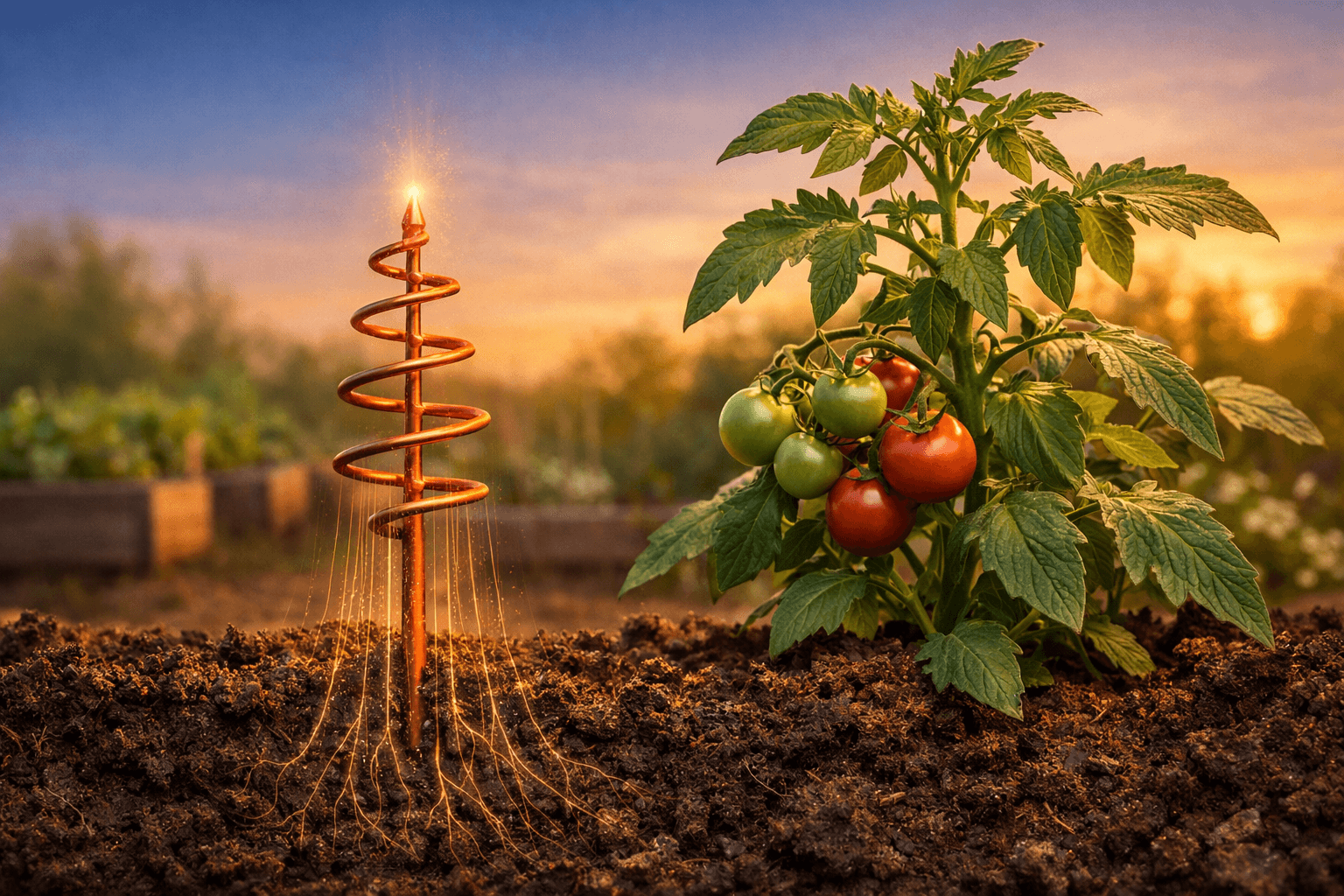
A copper antenna stuck in the soil acts as a conduit. Copper is one of the best natural conductors on Earth. It collects that atmospheric charge and channels it into the ground, into the root zone of your plants.
What happens next is where it gets interesting:
- The mild electrical stimulation encourages root growth and nutrient uptake
- Soil microorganisms become more active — they respond to the electrical environment
- Water molecules in the soil may be restructured, improving absorption
- The copper itself has antimicrobial properties that discourage harmful pathogens
Nobody has a single, tidy explanation for everything that's happening underground. And honestly, that's fine. We don't fully understand how aspirin works either, but we still take it when our head hurts.
What People Actually Notice
I've talked to hundreds of gardeners and small-scale farmers who use electroculture. The patterns are remarkably consistent:
- Faster, more vigorous growth. Plants come up quicker and grow taller. Side-by-side comparisons with untreated beds are hard to argue with.
- Healthier plants overall. Leaves are greener, stems are thicker, and the plants just look like they're doing well.
- Fewer pests. This one surprises people. There are theories about why — the electrical environment may be less hospitable to certain insects — but whatever the reason, people consistently report fewer pest problems.
- Better yields. More tomatoes. Bigger squash. Heavier harvests. The kind of results that make your neighbor walk over and ask what you're doing.
- Less water needed. Several growers have told me their water usage dropped noticeably. The soil seems to retain moisture better around the antennas.
A Note on Expectations
Does every single plant in every single garden respond identically? No. Gardening doesn't work that way, and anyone who promises you guaranteed results is selling something. But the trend is clear and consistent across a lot of different climates, soil types, and plant varieties.
It's Not Magic. It's Physics.
This is probably the most important thing I can tell you. Electroculture is not magic. It's not crystal healing for your tomatoes. It's not "manifesting abundance" in your raised bed.
It's applied physics. Crude, simple, low-tech applied physics. The kind of thing that makes perfect sense once you stop and think about it — plants are electrical organisms living in an electrical environment. Of course they respond to changes in that environment.
We accept that lightning helps grass grow greener. We accept that earthworms respond to electrical signals in the soil. But suggest that a copper antenna might channel atmospheric energy to help plants, and suddenly you're a lunatic. The double standard is worth noticing.
How to Get Started
This is the part that throws people off because they expect complexity. There isn't any.
Get a piece of copper wire. Wrap it into a coil or a simple spiral shape. Stick it in the ground near your plants. Point it up. That's your antenna.
Some people get more elaborate — directional coils, specific lengths based on the golden ratio, particular gauges of wire. And that's fine if you want to experiment. But the baseline is dead simple: copper in the ground, pointing at the sky.
We sell antennas that are designed and shaped for this purpose, but honestly, even a basic piece of copper wire will get you started. I'd rather you try it with something from the hardware store than not try it at all.
What I've Seen in My Own Garden
I've watched my own garden transform since I started using copper antennas. The first year, I thought maybe I was imagining it. The tomatoes were bigger, sure, but maybe it was a good year. The peppers came in hotter — could be the weather.
By the second year, I stopped making excuses. The beds with antennas outpaced the ones without, every single time. The difference wasn't subtle. Visitors would point at specific sections and ask, "What's different over there?"
I've since pulled the antennas from control beds. Everything gets copper now. I'm not running experiments anymore. I'm just growing food.
You Don't Need to Understand All the Science
Look — you don't need a degree in electromagnetic theory to benefit from this. People have been growing food with the help of atmospheric energy for centuries. The science is catching up, slowly, because there's not a lot of grant money in "stick copper in dirt."
But the plants don't care about funding or peer review. They just respond.
If you've got a garden, try it. One antenna, one bed, one season. Watch what happens. That's more convincing than anything I could write here.